White Parasol (2008) – Ian Dicke (United States)
White Parasol was written in reaction to a 2008 BBC news article about the major loss of shelf-ice in Canada’s High Arctic:
“Loss of ice in the Arctic, and in particular the extensive sea-ice, has global implications. The ‘white parasol’ at the top of the planet reflects energy from the Sun straight back out into space, helping to cool the Earth. Further loss of Arctic ice will see radiation absorbed by darker seawater and snow-free land, potentially warming the Earth’s climate at an even faster rate than current observational data indicates.”
Ann adds: This is one of several pieces in a group about water and ice melting.
I played and spoke a bit about this piece for a group of theory and musicology students in February of 2023.
Someone in the class asked me what it was I liked so much about the work, and I guess because I’d been traveling and I was tired, I gave a completely (to me) unsatisfactory answer: that I liked the work because it has such an effective buildup. (I might as well have said, “Duuuuh, I like it because it’s cool.” Which it is, but it’s not a good scholarly reason to advocate for how brilliant a work it is, and why I find it so intellectually and viscerally engaging.)
It’s true that White Parasol has an effective buildup, but that’s not all. So I’ll talk a bit more here about what I like about the piece.
1. Tempo marking — very clever!
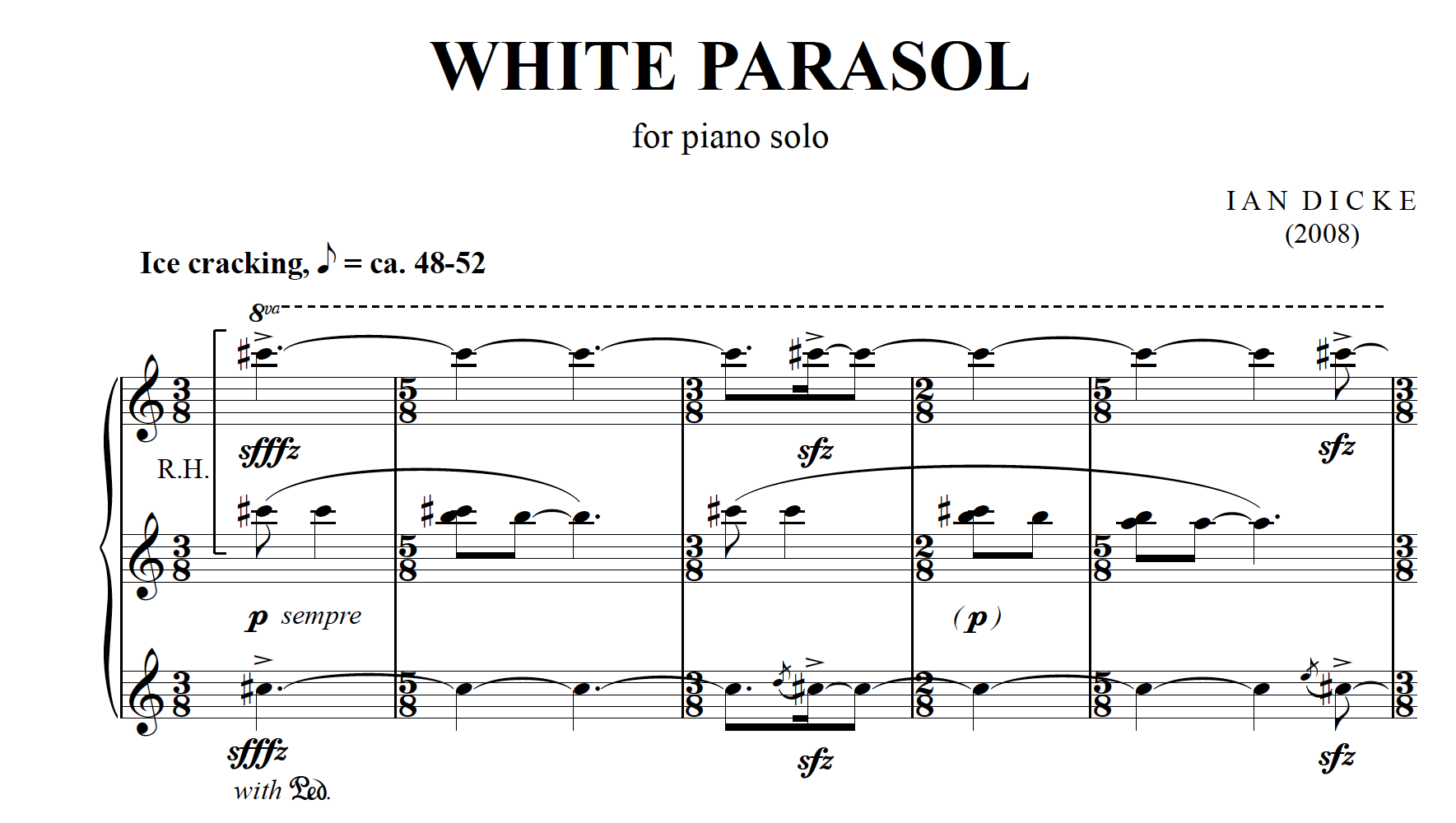
2. You can also see above some of the texture of the A section. There are three distinct lines in the treble, although the outer two move in parallel motion, like some 21st century chant that breaks all of the “rules” you learned in undergrad theory.
• Those outer voices are always accented (and sometimes, SUPER accented — see the sfffz markings).
• And they are frequently C sharps. Lots of C sharps in this piece. Daniel Blinkhorn’s piece frostbYte-chalk outline also has a lot of C sharps (mostly in C-sharp 7 chords; and, it’s the very first note the piano plays, just like this piece!). It almost makes me think that maybe C sharp is the sound of ice cracking. Can anyone out there with perfect pitch for sounds in the natural world confirm or deny?
3. Related to the texture, I also appreciate the middle voice, which is the melody, having an entirely different dynamic and character to the outer voices.
4. The harmonic rhythm of the piece — it starts slow (we don’t get another harmony until the D chord in first inversion in m. 19), which creates an effect of something that has been static for a long time beginning to move slowly. As the harmonic rhythm moves faster, so does the sea ice as it cracks (BTW, I haven’t actually asked Ian if that’s what this is musically depicting — it’s just what I as the performer of the piece hear and imagine). Then faster, then faster. The melodic motives start to speed up, too, as we approach the center of the piece.
5. As the harmonic rhythm and the melodic motives speed up, the effect is of the texture thickening. Simultaneously, the dynamics continue to grow louder. As part of this ever-increasing texture and ever-growing dynamic, a new motive of fast (64ths) repeated notes is introduced. The 64ths crescendo to fff, then abruptly stop.
6. The B section is almost impressionistic in its texture and harmonies — molto espressivo and piano arpeggiations.
[Again, because I’ve practiced the piece so much, I have in image in my head. This part reminds me of a section from the book The Ministry for the Future* where one of the solutions is to pump out water from beneath Antarctica’s glaciers to prevent them from sliding into the ocean where they’d just melt and raise sea levels that much more.
*Non-sequitur: I didn’t actually like TMftF all that much, and if you’re interested, you can read my thoughts on it here.]
7. The B section reaches its culmination;
Then: CRASH.
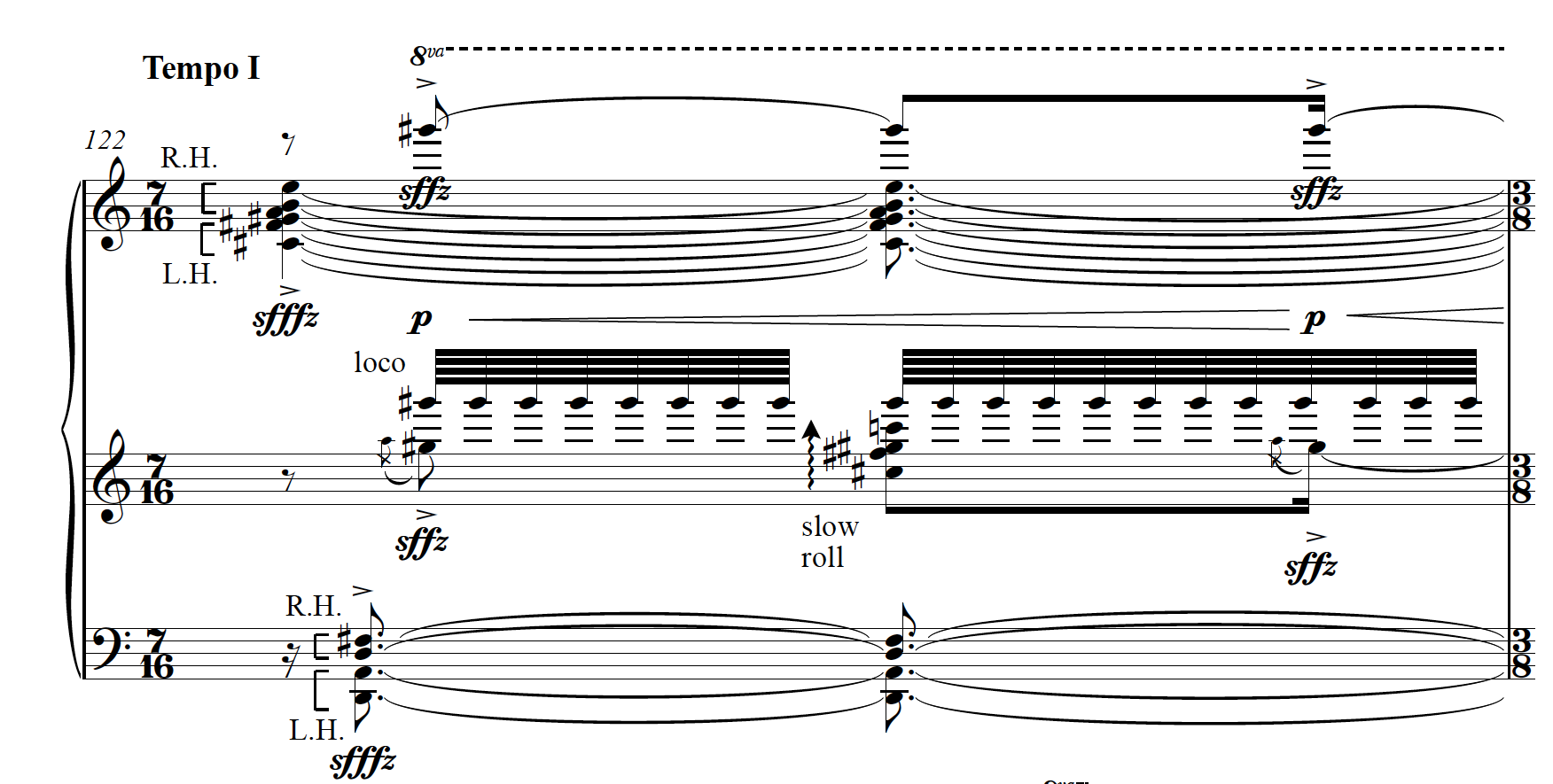
I hear echoes of deep time (see Robert MacFarlane’s Underland: A Deep Time Journey). Also very satisfying to play!
8. The final passage contains some canonic moments — to me, this is like a refraction, like looking through ice. (Again, deep time).
Alright, now I am marginally satisfied that I have provided a better answer to “Ann, why do you like this piece so much?”

Ian Dicke is a composer inspired by social-political culture and music technology. Praised for his “refreshingly well-structured” (Feast of Music) and “uncommonly memorable” (Sequenza 21) catalogue of works, Dicke’s music has been commissioned and performed by ensembles and soloists around the world, including the New World Symphony, Alarm Will Sound, the Cabrillo Festival Orchestra, Paul Dresher Ensemble, pianist Vicky Chow, The MATA Festival, ISCM World New Music Days, and the Atlantic Coast Center Band Director’s Association. Dicke has received grants, awards, and recognition from the Hellman Foundation, Barlow Endowment, San Francisco Conservatory of Music, New Music USA, New York Youth Symphony, ASCAP, and BMI, among others. He was awarded a Fulbright Fellowship to research interactive musical interfaces and environments in Stockholm, Sweden and has served as an artist in residence at various institutions, including MacDowell and Atlantic Center for the Arts.
In addition to his creative activities as a composer, Dicke runs Novel Music, a software company that specializes in unique and intuitive instruments designed to encourage happy accidents and inspire new musical ideas.
He is also the founder and curator of the Outpost Concert Series which connects Riverside, California’s musical culture with groundbreaking artists across the national contemporary music landscape. Dicke currently serves as an Associate Professor of Composition at the University of California, Riverside. For more information on works in progress, upcoming performances, commissioning, and score purchases, please visit www.iandicke.com.
 Ann DuHamel